A soft path underfoot
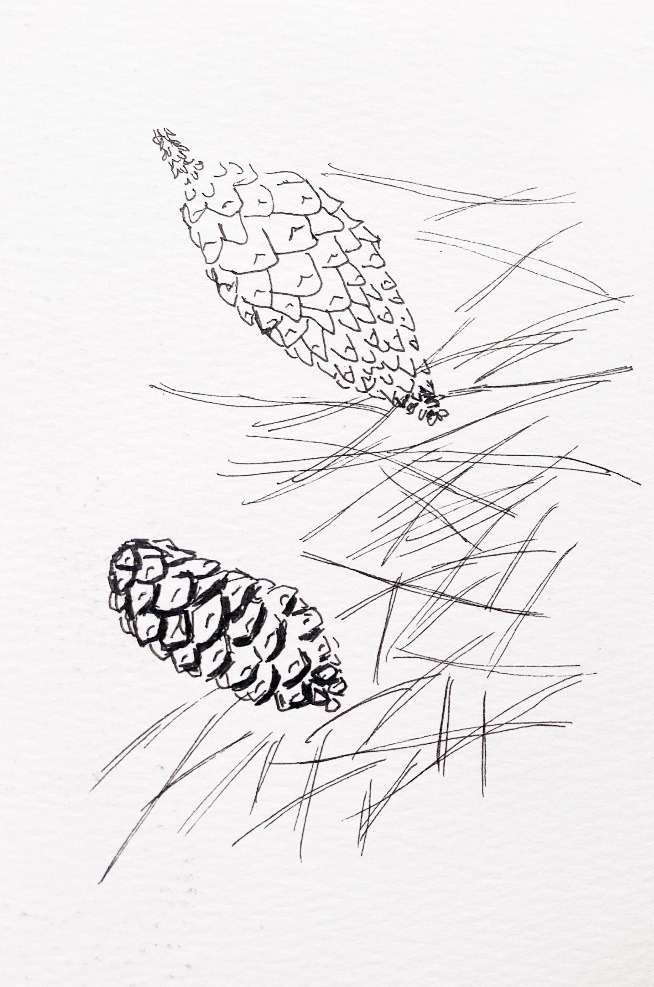
The archived account describes the pleasure of walking through pines. Light passes through the needle canopy, fallen needles soften the ground, and cones lie scattered across the surface. Air moves between the sparsely branched trunks, bringing the sound of wind in the trees. Wild flowering shrubs grow in places without footsteps.
The sketch of cones and needles accompanies a much longer essay. It begins with the immediate experience of a plantation, including its comfort and beauty, before asking how this kind of woodland came to occupy a place within the wider forest landscape.
Different trees, different ground
Other passages in the source describe rubber, eucalyptus and acacia plantings. Attention moves downward from their canopies to the ground beneath. The account records exposed reddish soil in worked rubber stands, a feeling of dryness beneath eucalyptus, and abundant undergrowth around acacias. These observations belong to the source's comparison of planted environments; they do not establish the presence of these plants in the project's current fieldwork area.
The differences prompt questions about the values behind commercial forestry. Growth, timber, resin and the needs of particular industries help determine which trees are planted. The essay questions a narrow account of prosperity that measures success through speed, volume and price while overlooking ecological costs and the people whose lives depend on the land.
Accepting a complicated landscape
The essay does not treat every introduced tree as an ecological disaster. It acknowledges that plantations have different effects and that an unfamiliar origin alone cannot settle the question of their place. The criticism turns toward simplified development stories and the pressure to make diverse landscapes serve a uniform model of production.
This concern is connected with a wider land ethic: the ability to see a tree's place in its home landscape belongs alongside the ability to recognize a person's claim to a life there. Returning to the pines at the end, the essay favors accepting the trees already present while continuing to imagine a different future. The pleasure of the walk and the unease it provokes remain together.