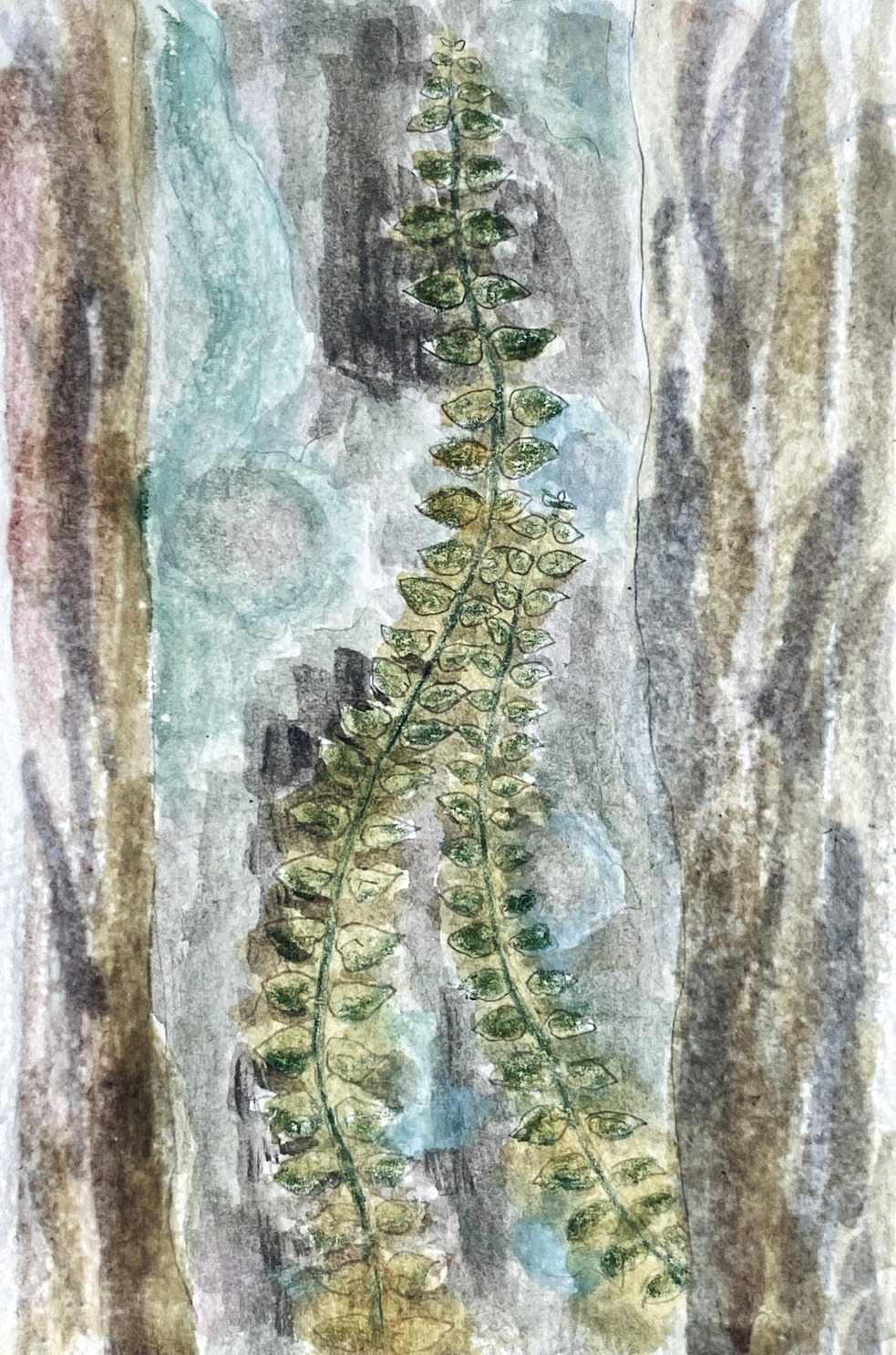
Blue against brown and green
The field note follows a familiar forest walking route, passing through a pine wood where resin is still being collected and stopping on a ridge. A tree's relatively smooth bark carries pale blue lichen. Against the browns and greens of the surroundings, the color draws the observer's attention; its arrangement brings Van Gogh's starry sky to mind.
Two climbing plants occupy the same trunk. Small leaves follow their winding stems upward, creating another pattern across the surface. The resulting drawing holds these different forms together: the patches of color, the upright trunk and the plants using it as a route toward the light.
An encounter with interdependence
The essay asks how earlier observers might have understood lichen. Would someone meeting these colored patches without a modern biological education immediately recognize them as living? The question leads to a consideration of lichen as a relationship between fungi and photosynthetic partners, and of what a closer view might reveal.
In the essay's account, the partners provide one another with conditions and resources that make their shared existence possible. Images of lichen's minute structures become another way of thinking about life. The tree becomes a place where something seen at close range opens onto relationships that cannot be grasped from appearance alone.
Reaching for sunlight
The reflection moves beyond the organism pictured. The essay questions the habit of arranging other lives into simple categories of friend and enemy, suggesting that such divisions can prevent people from learning from their relationships. This is the philosophical movement of the text, rather than a claim that every biological encounter is harmonious.
As the drawing develops, the climbing plants are imagined as almost animal-like in their movement, their stems twisting toward higher places to enjoy the light. The closing thought gives this observation a playful, sensory form: if plants could taste sunlight, perhaps it would be sweet. The speculation remains recognizably imaginative, returning a broad meditation on interdependence to the particular tree described in the field note.